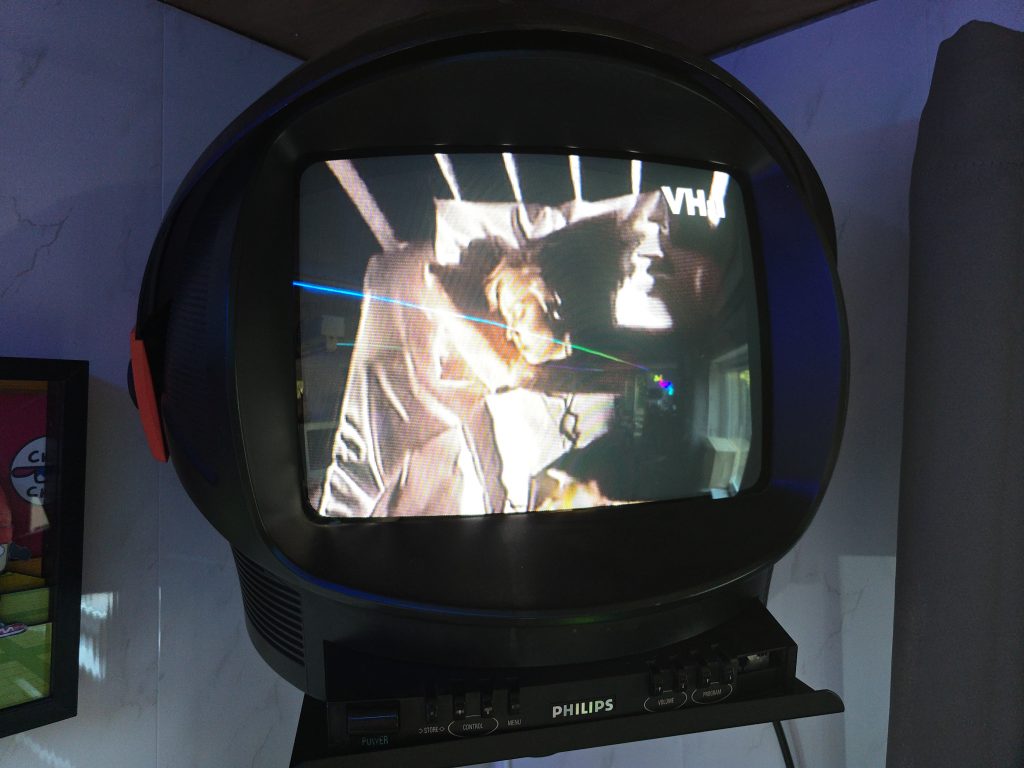
I was sitting down in my retro room the other day listening to some 80s/90s music videos on my Philips Discoverer TV, when all of a sudden it went very quiet.
I got it onto my work bench and started to have a look around to see what the issue was. The first thing to test was the power rails, and this is where I came across the first issue. There was no B+ voltage.
I downloaded the schematics and discovered that the power supply in this unit is a bit different to what I have worked on before.
With this unit, the 5v, 9V and 95v (B+) are generated by the switched-mode power supply, but there is then a 12v that is required to run the horizontal oscillator IC. The strange part (to me at least), is that the 12V rail comes from the output of the flyback. But the Flyback needs the horizontal oscillator to run. And for that to run, it needs the 12v generated by the flyback.
After going around in a circle a few times, I came to the conclusion that something was different here. The way this set actually works is that when it is powered on, a small startup voltage is sent to pin 11 or the horizontal oscillator, which kicks it into life and generates the 12v for a brief period. But once this 12v exists, it can then run the oscillator via its power input pin.
The problem with this setup is that it is difficult to measure the voltages as they only exist for a split second. I did however, disconnect the deflection coil to isolate the 95v rail and was able to see that it was nice and stable at least.
The 9v rail however, was showing as around 4.7v which definitely didn’t look right.
My assumption here was that I had a short on the flyback, but I went down another rabbit hole here. I do own a ring tester, which allows you to test the coils on transformers. I hooked this up and got a reading of 45, which to me didn’t seem like a failed result. Normally, a bad short will show a very low number.
After testing a whole bunch of other components and not finding any issues, I eventually decided that the flyback had to be the issue, despite the test result. Luckily, I was able to source a replacement flyback off eBay, and once it arrived, I fitted it, and the set sprang back into life.
My guess is the faulty flyback had failed in such a way that the low-voltage used by the tester wasn’t powerful enough to show the issue. But once the 10,000v+ was running through it, the short was present.
My takeaway from this is that if the ring tester says a flyback is faulty, then it is most likely faulty. But if it says it is ok, then it still could be faulty lol.
If you have one of these sets and your 9v rail is being pulled down, then there is a high probability that the flyback has failed.
At least the Philips Discover now lives again 🙂
Some of those CRT TVs and Monitors certainly had some “novel” ways of generating signals and power!! Well diagnosed and thanks for sharing!!